After the thaw…

** ARCHIVED POST – LINKS AND IMAGES MAY NOT WORK**
— by Beth Erwin

Folks have lots of questions about the effects of the great freeze on their native plants.

Let’s start with the ones that require the most effort and money to deal with — trees.  Most of the limbs on the ground are from Live Oak trees.  In our area they are typically evergreen, and a heavy load of ice on the leaves will bring the limbs crashing down and cause forked trunks to split in two.

Where small limbs have broken off the tree, if at all possible, those jagged breaks left on the tree need to be cleanly pruned back to a branch of similar size, a main limb or the trunk.  Cuts need to be painted immediately to deter the sap-feeding insects that spread Oak Wilt.

Trees that have split in two, or half of the tree has broken off, need to be removed completely.  It is nearly impossible to properly treat the wound caused by a split and the remaining portion of the plant becomes a liability.  This advice applies to all trees, large and small.

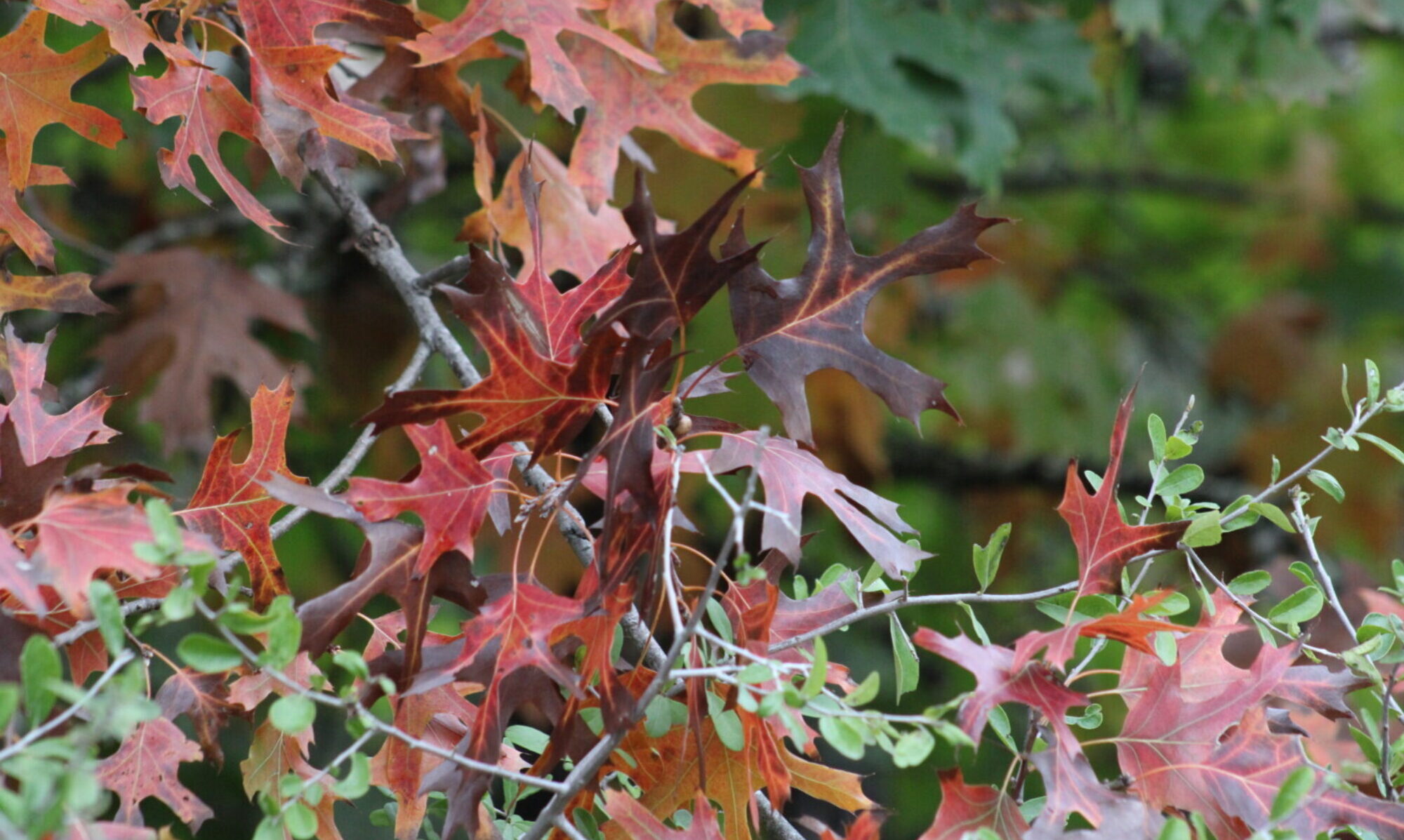
Most Live Oaks are showing signs of freeze burn on most of the leaves.  That means they will probably start shedding those leaves early.  If your method of disposing of leaves involves putting them in paper compost bags to be picked up at the street, stop reading right now and run to the store and get some bags.  They are going to get scarce.

Smaller trees and large shrubs need the same type pruning treatment.  Check the trunks of smaller trees for splitting bark.  Any trunks or limbs with linear splits showing bare wood underneath can be removed as they are not likely to survive.

With shrubs and perennials, it is a waiting game.  Perennials that have been in place for years and are well established will likely survive.  The Turk’s Cap and Texas Lantana you expect to see sprouting along the branches when spring arrives may end up sprouting anew from the ground instead.  The critical point for many of these plants will be tied to the soil temperature.  Remember, a few 80-degree days will not raise the soil temperature.  It takes a significant number of days with warm day and night temperatures to really kickstart the growing season.  If it looks like dead stalks, and you just cannot stand it, you can snip away small amounts until you reach green wood or scratch the bark surface to see if it lives.

Cultivate patience with your plants.  Give shrubs and perennials until the middle of June to determine if they will recover.  If you are ready to replace your non-native species for more dependable Texas natives, come see us at the Spring plant sale March 26-27 at Berry Springs Park & Preserve.

** ARCHIVED POST – LINKS AND IMAGES MAY NOT WORK**
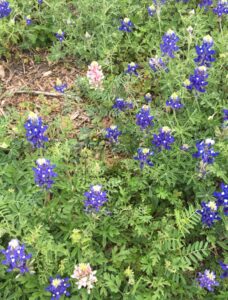
Save the Date: NPSOT-Wilco Spring Plant Sale, March 26 & 27!

** ARCHIVED POST – LINKS AND IMAGES MAY NOT WORK**
[3/21 10:30pm, list correction. 3/21, 3/11, 3/4, 2/13 plant list updates. 3/13, volunteer link added. PD]

Drop by the Williamson County Chapter’s Spring Plant Sale on Friday March 26 and Saturday March 27, 9am-5pm, at Berry Springs Park & Preserve in Georgetown, TX.

You’re sure to find a great selection of locally grown Texas native plants just right for your yard.  As always, our knowledgeable sales assistants will help you find just what you need.

You’ll find a list of plants offered later in this post. We’ll also take special orders!  To inquire about a special order, or for other questions, contact Beth Erwin, plant sale leader, using this form. [Updated 3/21: the special order window is now closed since we are close to the sale days.]

  • What:   NPSOT-Wilco Spring Plant Sale
  • When:  Friday, March 26, 2021, and Saturday, March 27, 2021, 9am-5pm on both days
  • Where: Tonkawa Pavilion (main group pavilion) at Berry Springs Park & Preserve, 1801 Co Rd 152, Georgetown, TX 78626
  • Open to the public. Park entry is free.
  • Please note that face masks and social distancing are required. 

If you would like to volunteer at the sale, see the volunteer info and form in this post.  [As of 3/13, there are still some openings.]

Plants to be offered as of March 21, 2021:

  • Note: the March 21 list is the last list before the sale.  Prices have been updated on the last page. Lined out listings are plants that have developed unexpected post-freeze issues, or are not showing signs of recovery in time for the sale. We realize that folks were counting on purchasing some of those species at the sale. We chose to strike through rather than delete to let folks know why they will not be there. We hope we can offer them in the fall sale.
  • The newest list is in the window below. Use the tools under the >> signs to download or print it, or you can find the same March 21 PDF at this link.  Update @3/21 10:30PM Accidentally left off the list–We will also have Red Autumn Sage (Salvia greggii), Damianita, and Goldenball Lead Tree. (Links to older lists are towards the end of this post just in case you need one.)
  • If we update the list, we’ll update this blog post to link to the new file (with the new date in the upper left on page 1) and we’ll send blog subscribers an alert so they know about the update. (Subscribe to the blog in the menu on the right-hand side of this page.)

Click to access Plant_Sale_List-03-21-2021.pdf

  • In case you need the older information, previous lists for this sale were:
    • March 11 list
    • March 4 list
    • February 13.  This was the preliminary list of plants to be offered. Please be advised this list was made before the Great Valentine’s Day Freeze.

Other Plant Sale News [updated 3/21]

Lady Bird Johnson Wildflower Center is having a sale every weekend in April and May. Reservations required. See details on the LBJWC website.

** ARCHIVED POST – LINKS AND IMAGES MAY NOT WORK**
Online Chapter Meeting Feb 11: “Texas Native Plants and Climate Change” with George Diggs

** ARCHIVED POST – LINKS AND IMAGES MAY NOT WORK**

[Updated 01/26/2021 to add Zoom registration info. PD]

Join NPSOT-Wilco’s online chapter meeting on Thursday, February 11, 2021, at 7:00 pm, when guest speaker George Diggs will present Texas Native Plants and Climate Change.

You must register in advance to attend the meeting.  See the instructions later in this post.

image of person

About the topic:  George will briefly summarize the most recent evidence for climate change and will discuss his personal observations from Antarctica to the Arctic.  It is now clear that climate change is having effects on plants and animals both around the globe and here in Texas.  Many species are now becoming mismatched to their rapidly changing environments.  A variety of specific examples will be discussed that demonstrate the impacts of climate change, both large and small, and from those that affect whole regions to our own backyards.  Plant examples in Texas span the state from the Gulf Coast and Pineywoods to central Texas and the Trans-Pecos.

About our speaker:  George Diggs is an evolutionary biologist and botanist who has taught for 40 years at Austin College in Sherman, and a Research Associate at the Botanical Research Institute of Texas.  His research interests include the plants of Texas, evolution as it relates to human health, climate change, and biogeography.  He has co-authored four books and more than 30 scientific articles.  In his research he has traveled to all seven continents.  His latest books are The Hunter-Gatherer Within: Health and the Natural Human Diet, co-authored with Dr. Kerry Brock, and The Ferns & Lycophytes of Texas, co-authored with Barney Lipscomb. 

How to attend:   You must register in advance to attend the meeting. Register at the link below.


NPSOT-Williamson County meetings are free and open to the public. In this time of public health risk, our in-person meetings and field trips are canceled until further notice.

Check our blog announcements, calendar and Facebook for developing plans for virtual meetings and virtual field trips.

** ARCHIVED POST – LINKS AND IMAGES MAY NOT WORK**