** ARCHIVED POST – LINKS AND IMAGES MAY NOT WORK**
Wednesday, March 24, 2021, is the last day NPSOT-Wilco chapter members may cast votes on revisions proposed to our chapter bylaws. If you have already voted, thank you! If you have not yet voted, you still have time. Only chapter members are eligible to vote.
If you are a NPSOT-Wilco chapter member and you do not see the ballot email in your inbox, please check your spam folder. (Ballots were sent on February 21 to chapter email addresses in the state’s member database.)
NPSOT-Wilco’s current board of directors recommends amending our chapter bylaws to define that either electronic or in-person member voting is allowed on chapter business. The proposed revisions were announced in this post on February 21. See the draft document on the chapter website under Who We Are->Chapter Documents->NPSOT-Wilco Bylaws-proposed.
If you have questions about a proposed change, please contact Randy Pensabene at wilco-chapter@npsot.org.
** ARCHIVED POST – LINKS AND IMAGES MAY NOT WORK**
** ARCHIVED POST – LINKS AND IMAGES MAY NOT WORK**
[Updated 3/2/2021 with Zoom info. PD]
Join NPSOT-Wilco’s online chapter meeting on Thursday, March 11, 2021, at 7:00 pm, when author Mary Irish will present Creating a Perennial Border with Native Plants.
You must register in advance to attend the meeting. See the instructions later in this post.
At every meeting, we give away a book — about native plants or the meeting topic — to one randomly chosen meeting attendee!
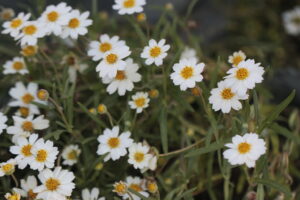
Blackfoot Daisy, Melampodium leucanthum. Photo by Bob Kamper.
About the topic: Perennial borders are a long used design feature, but few are devoted to native plants. In building a native plant border we learned valuable lessons in how this can be achieved and the great rewards it offers a gardener.
About our speaker:Mary Irish is garden writer, lecturer and educator. She lived and worked in Arizona for 25 years. She is a native Texan who returned in 2012 and until her retirement in the spring of 2019 worked the San Antonio Botanical Garden managing the Garden’s plant sale program. She and her husband Gary live in Castroville, Texas – a historic town in the South Texas plains.
She is the author with Gary Irish of Agaves, Yuccas and Related Plants (Timber Press, 2000), Gardening in the Desert (University of Arizona Press, 2000), Arizona Gardener’s Guide (Cool Springs Press, 2003), Month by Month Gardening in the Desert Southwest (Cool Springs Press, 2003) with a revised edition entitled Gardening in the Desert of Arizona in 2008, Perennials for the Southwest, (Timber Press, 2006), Trees and Shrubs for the Southwest (Timber Press, 2008), A Place All Our Own (University of Arizona Press, 2012), Texas Getting Started Garden Guide (Cool Springs Press, 2013) and with Judith Phillips, Arizona-New Mexico Getting Started Garden Guide (Cool Springs Press, 2014) and Gardening on the Dry Side, Texas A&M Press.
Irish has worked as a consultant on projects for the Sunnyland Administrative Center, Sunnyland Center and Gardens in Rancho Mirage, California, Myriad Botanical Garden in Oklahoma City, downtown plantings for the City of Scottsdale, the Xeriscape Demonstration Garden in Glendale, Arizona, as well for numerous homeowner associations and private gardens.
Irish teaches classes regularly on the use and cultivation of agaves and succulents, woody plants, and low water use perennials. Her plant interests range widely with agaves and their relatives, bulbs and drought hardy perennials at the top of the list.
She served as the Director of Public Horticulture at the Desert Botanical Garden in Phoenix for 11 years ending in 1999. She has served on the Board of the Arizona Nursery Association for 10 years, Native Seeds/SEARCH for 3 years and Boyce Thompson Arboretum for 9 years, 6 as the Chair.
She has a B.A. from the University of Texas at Austin and M.S. in Geography from Texas A&M University.
NPSOT-Williamson County meetings are free and open to the public. In this time of public health risk, our in-person meetings and field trips are canceled until further notice.
Check our blog announcements, calendar and Facebook for developing plans for virtual meetings and virtual field trips.
** ARCHIVED POST – LINKS AND IMAGES MAY NOT WORK**
** ARCHIVED POST – LINKS AND IMAGES MAY NOT WORK**
— by Beth Erwin
A fundamental element for attracting birds to your yard is a brush pile. The familiar perching birds in our backyards like wrens, chickadees, titmice, and cardinals will appreciate the extra spot to dart into for cover. In turn, their activity will attract other birds that are passing through to check out your space for hanging out.
The recent winter storm has left plenty of material for brush piles. If you already keep a brush pile on hand for the birds, this might be a good time to refresh and relocate it. A brush pile left in the same place becomes a feeding station for predators after a couple of years, much like bird houses without predator guards. Your resident birds catch on quickly when the neighbor’s cat or a rat snake starts lurking in or near the pile. Migrants and casual visitors remain on the menu. In addition, the limbs at the bottom of the brush pile begin to disintegrate and pack down, leaving less space to dart around in.
You do not have to move far from the first brush pile when you relocate. You are going to have a bare spot where the old pile was. You can look for sprouts of the seeds the birds have left you once the ground is exposed to light or use the space to plant some native annuals or perennials. It should be rich in decomposed organic matter.
For those of you who cannot bear the thought of a pile of limbs in your yard, cohabitate with such a person, or know that your HOA would have a fit, try thinking outside the box. There is no rule on how the brush should be stacked other than there needs to be space for small birds to dart into when fleeing for cover.
Stand the limbs up, cut ends to the ground, bind the top ends together and make a cone/teepee shaped pile. Another option is to cut the thicker branches in pieces of the same length and stack them much like a split rail fence, only create a square tower configuration. Add some twigs in the center. Artistic brush piles! Please post pictures on our social media pages-> Facebook or Instagram.
** ARCHIVED POST – LINKS AND IMAGES MAY NOT WORK**